
December 2025
New frameworks for biologically constrained learning: from similarities in humans and transformers and sparse, contrained RNNs to a unified theory of hippocampal replay
Shared sensitivity to data distribution during learning in humans and transformer networks
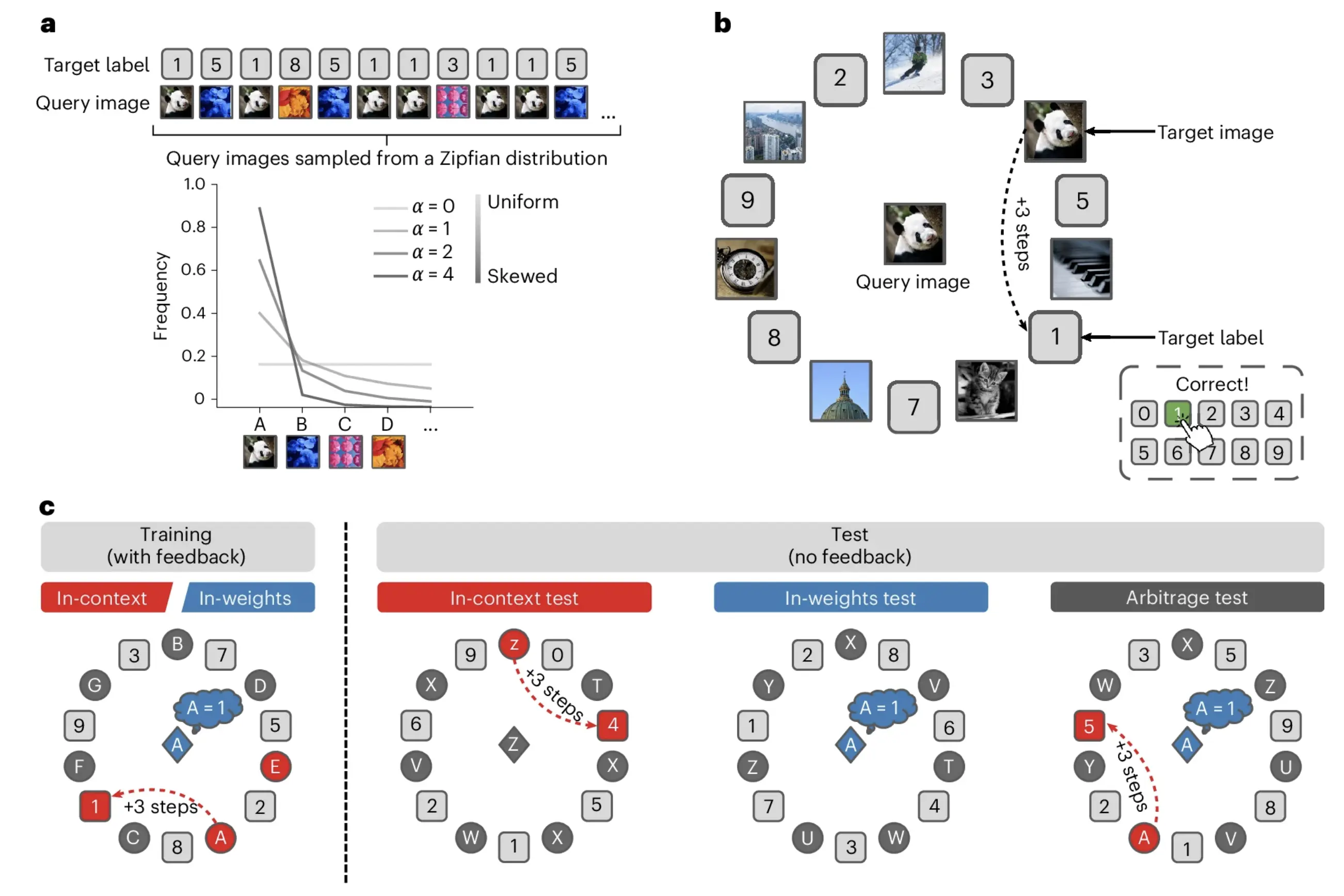
- Core Discovery: Humans and transformer networks share a specific sensitivity to the statistical distribution of training data, trading off between “in-context” (inference-based) and “in-weights” (memory-based) learning strategies.
- Method: The study compared humans () and transformers on a rule-learning task, manipulating the diversity (Zipfian skewness) and redundancy of examples.
- Findings:
- Both learners switch strategies at a similar threshold (): high diversity promotes in-context generalization, while high redundancy promotes rote memorization.
- A composite distribution (balanced diversity and redundancy) allows both systems to acquire both strategies simultaneously.
- Critical Divergence: Humans benefit from a curriculum that emphasizes diversity early, whereas transformers suffer from catastrophic interference, overwriting early strategies with later ones.
- Conclusion: While humans and transformers share computational principles regarding data distribution, biological memory constraints allow for flexible curriculum learning that current transformer architectures lack.
Between planning and map building: Prioritizing replay when future goals are uncertain
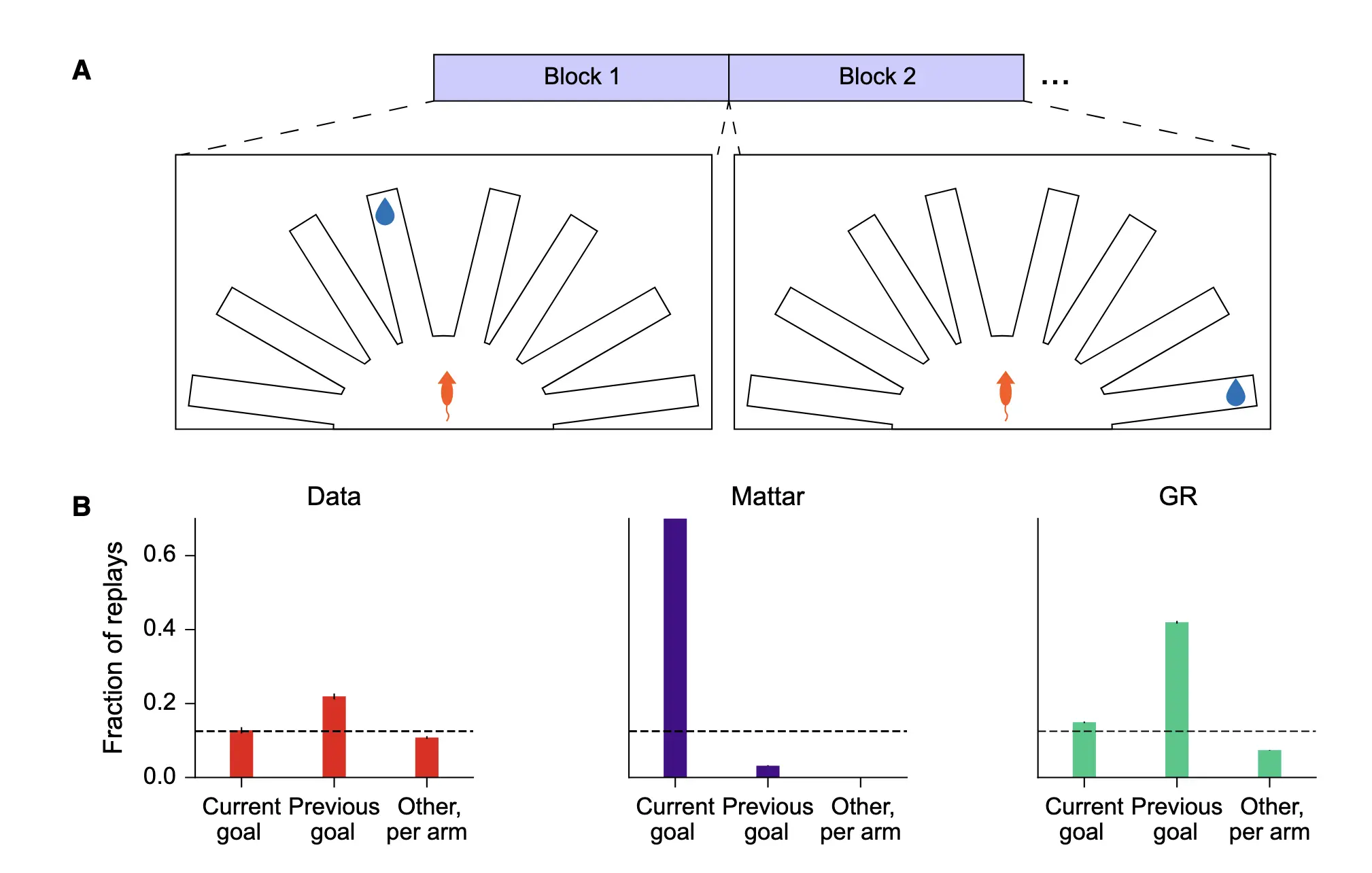
- Objective: To reconcile the “value” hypothesis (replay plans for current goals) and the “map” hypothesis (replay builds structure) of hippocampal function.
- Approach: The authors extended a reinforcement learning planning model to include a Geodesic Representation (GR)—a map encoding distances to multiple candidate goals—prioritized by their expected future utility.
- Results:
- The model explains “paradoxical” lagged replay (focusing on past rather than current goals) observed in goal-switching tasks as a rational response to uncertainty about future goal statistics.
- It simultaneously accounts for predictive replay in stable environments where the goal structure is well-learned.
- Replay prioritization depends on the agent’s learned belief about goal stability and recurrence.
- Implications: Replay functionally builds a cognitive map (GR) but prioritizes its construction based on future relevance, unifying planning and map-building under a single computational framework.
Constructing biologically constrained RNNs via Dale’s backpropagation and topologically informed pruning
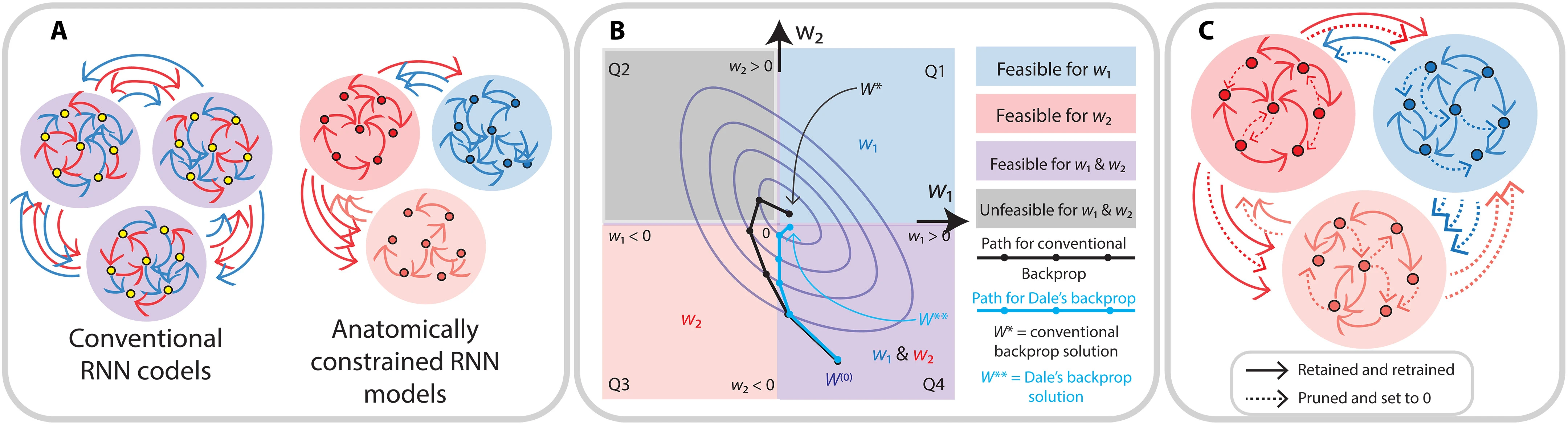
- Scope: A new framework for training Recurrent Neural Networks (RNNs) that rigorously adhere to biological constraints: Dale’s principle (separate E/I neurons) and sparse connectivity.
- Key Themes:
- Method: Introduces “Dale’s backpropagation” (a projected gradient method) and “top-prob pruning” (probabilistically retaining strong weights) to enforce constraints without performance loss.
- Performance: Constrained models empirically match the learning capability of conventional, unconstrained RNNs.
- Application: When trained on mouse visual cortex data, the models inferred connectivity patterns that support predictive coding: feedforward pathways signaling prediction errors and feedback pathways modulating processing based on context.
- Framework Proposal: This approach provides a mathematically grounded toolkit for constructing anatomically faithful circuit models, bridging the gap between artificial network trainability and biological plausibility.
References
- 1
- 2
- 3